
EU-ZIRA3A
Technical Committee Advances Coordination on TVET and Sustainable Waste
Management
Cairo, 21
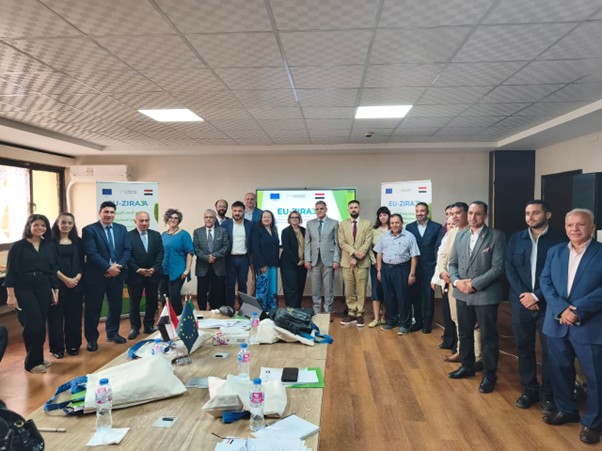
September 2026 — The EU-ZIRA3A Technical Committee
convened this week to advance coordination on key priorities for sustainable
rural development, bringing together the EU Delegation, Italian Agency for
Development Cooperation (AICS), and the EU-ZIRA3A team with representatives of
the Ministry of Agriculture and Land Reclamation, Ministry of Education and
Technical Education, Ministry of Water Resources and Irrigation, and Ministry
of Local Development and Environment.
Led by Dr. Ahmed
Rizk, Head of Sector of Agricultural Services, and Iva Stamnova, EU Programme
Manager for Agriculture, the meeting focused on the Programme’s Technical and
Vocational Education and Training (TVET) and Waste Management components, with
discussions centred on sustainability, institutional coordination and alignment
with national priorities.
Connecting
agricultural education with future opportunities
Under the TVET
component, participants discussed the selection of agricultural technical
schools to be supported and the criteria for their assessment. The Ministry of
Education and Technical Education has already prepared an initial list of
candidate schools, which will undergo further verification and formal
assessment.
Discussions also
emphasised the importance of ensuring that supplementary training modules are
accredited and closely aligned with the agricultural value chains supported by
EU-ZIRA3A. This approach aims to ensure that students acquire skills that
respond to real opportunities in their local economies.
Beyond technical
and agricultural skills, participants highlighted the importance of introducing
entrepreneurship and small-business development into the training offer.
Stronger engagement with the private sector was also identified as an important
pathway for connecting students with employment and business opportunities.
The Committee
also stressed that interventions should be designed for long-term
sustainability and potential scale-up, rather than as one-off activities.
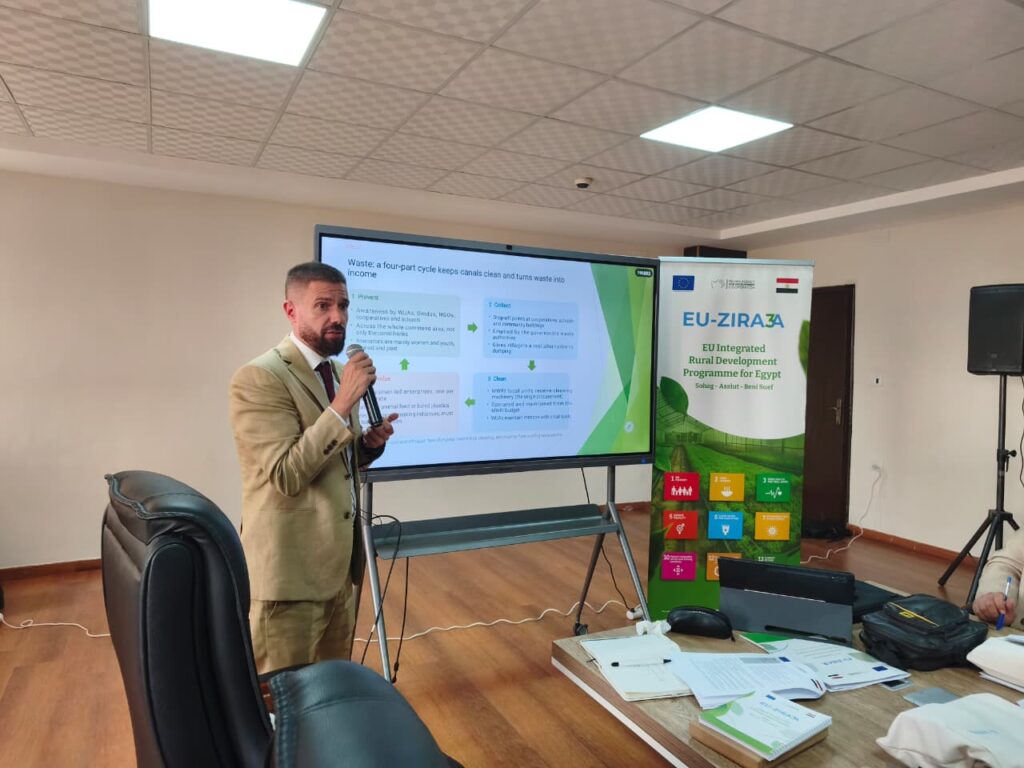
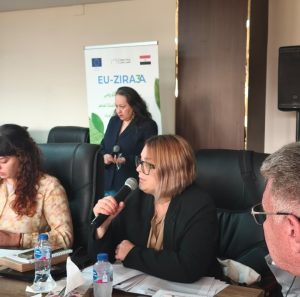
From canal
cleaning to sustainable waste management
The Waste
Management component focused on one of the practical challenges facing rural
communities: the management and disposal of waste removed from irrigation
canals.
Participants
discussed the need for stronger coordination between the Ministry of Water
Resources and Irrigation and the Ministry of Local Development to establish
appropriate arrangements for waste collection and disposal, while
distinguishing between organic waste and other waste streams.
The discussions
went beyond waste removal to explore opportunities for productive use of waste
and rural entrepreneurship. Participants highlighted a potential three-stage
approach: raising awareness along irrigation canals, identifying opportunities
to make productive use of waste, including dedicated opportunities for women, and
supporting entrepreneurship around these activities.
The importance
of community participation was also emphasised, recognising that sustainable
waste management depends not only on infrastructure and institutional
arrangements, but also on awareness and local ownership.
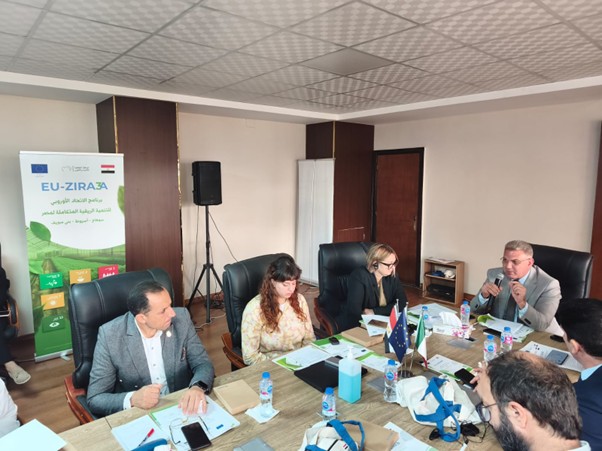
Building
sustainable and scalable models
Sustainability
emerged as a central principle across both components. Participants stressed
the importance of designing interventions that can be maintained over time and
potentially scaled across Sohag, Assiut and Beni Suef.
The Committee
also highlighted the potential role of SMEs and NGOs as implementing and
supporting partners, as well as the need to formalise cooperation between
EU-ZIRA3A, the Ministry of Water Resources and Irrigation, and the Ministry of
Local Development.
The Waste
Management component was considered approved and feasible, while the TVET and
Waste Management concepts received initial approval. A Steering Committee will
be organised for further endorsement, with detailed activities to be developed
through subsequent discussions with the relevant stakeholders.
The meeting
reinforced the shared commitment to translating national priorities and
technical expertise into practical, sustainable solutions. By strengthening
agricultural skills, creating pathways for rural entrepreneurship, and
advancing more sustainable approaches to waste management, EU-ZIRA3A is working
to support stronger rural livelihoods and more resilient communities across
Upper Egypt.